Center News
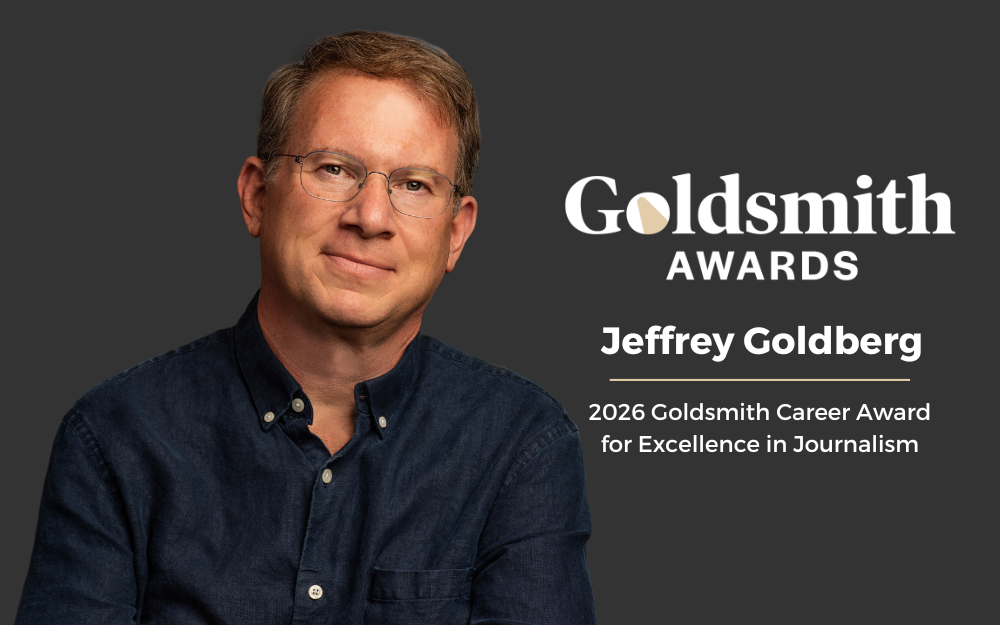
Jeffrey Goldberg to be honored with the 2026 Goldsmith Career Award for Excellence in Journalism

Center News

The Shorenstein Center on Media, Politics and Public Policy at Harvard Kennedy School is proud to announce the six finalists for the 2026 Goldsmith Prize for Investigative Reporting. The Goldsmith Prize, first awarded in 1993 and funded by a gift from the Greenfield Foundation, honors the best public service investigative journalism that has made an impact on local, state, or federal public policy or the practice of politics in the United States. Finalists receive $10,000, and the winner – to be announced at the April 9 ceremony – receives $25,000. All prize monies go to the journalist or team that produced the reporting.
“If there were any doubt about the continuing strength and impact of investigative reporting, this year’s finalists should silence the skeptics,” said Shorenstein Director Nancy Gibbs. “Because of their tireless work, Congressional committees held hearings, law enforcement launched or reopened investigations, and lawmakers introduced legislation and passed new laws. They have exposed fraud and corruption at every level of government and set a higher standard for transparency and accountability.”
The winner of the 2026 Goldsmith Prize for Investigative Reporting will be announced at the awards ceremony, to be held Apri 9, 2026, at the JFK Jr. Forum at Harvard’s Kennedy School of Government. The in-person ceremony will be livestreamed at GoldsmithAwards.org and ShorensteinCenter.org.
2026 GOLDSMITH PRIZE FOR INVESTIGATIVE REPORTING FINALISTS:
Abuse of Power: Beyond the Goon Squad
Brian Howey, Nate Rosenfield, Mukta Joshi, Jerry Mitchell, Steph Quinn, Sarah Cohen | Mississippi Today, The New York Times
In 2023, the team at Mississippi Today and The New York Times uncovered that, for a generation, sheriff’s deputies known as the “Goon Squad” tortured suspected drug users across Rankin County, Mississippi, beating, burning and waterboarding their victims until they shared information. That reporting prompted a Justice Department investigation and a new state law increasing police oversight. But, knowing that the full story was still unfolding, and in the face of mounting resistance and intimidation, the local and national collaboration continued reporting on the sheriff’s department. In 2025 they uncovered even more extensive abuses: a sheriff allegedly stealing inmate labor from local taxpayers for personal profit, a likely murder in the jail that had been written off as an accident, evidence of years of brutality in the jail, including a video showing guards shocking an intellectually disabled man with an electrified vest, and widespread abuse of Tasers by police across the state. This reporting led Mississippi lawmakers to propose two statewide Taser oversight laws, at least three investigations by state authorities and two probes by the FBI, a re-opened murder investigation, and several candidates indicating they will run against the sitting sheriff in 2027.
Exposed and Expendable
Hannah Dreier and the Staff of The New York Times | The New York Times
As wildfires swept through Los Angeles in January 2025, New York Times reporter Hannah Dreier noticed something strange – firefighters were working bare-faced for days on end, while residents were told to wear masks or stay indoors to protect themselves from dangerous air pollutants. In over 400 interviews, public records requests to eight agencies, an analysis of thousands of pages of individual medical and service records, and the creation of a database tracking every national crew deployment over the past two decades, Dreier discovered the dramatic and lasting consequences that firefighters were facing from fighting wildfires without protection, and that the Forest Service had understood the dangers of smoke for decades, but downplayed the risk. As a result of the reporting, Congress passed a bipartisan law, signed in December 2025, that requires the government to pay $450,000 to wildland firefighters who become disabled or die from smoke-related cancers. Five additional bills prompted by this reporting are still pending at the federal level, and it has also spurred state-level spending and regulation in California, as well as new OSHA and Forest Service protections for wildland firefighters, including the reversal of the Forest Service’s decades-long ban on masks.
Hope Florida
Alexandra Glorioso, Lawrence Mower, Justin Garcia | Tampa Bay Times, Miami Herald
Hope Florida was a much-touted program held up as an alternative to welfare by Florida Governor Ron DeSantis, and founded by his wife, Casey. Then, reporters from the Tampa Bay Times and Miami Herald found that it had almost no evidence of success, and the program’s charity arm, the Hope Florida Foundation, had received a mysterious $10 million donation from a state settlement and was refusing to turn over its tax records, in violation of IRS rules. Working against state agencies that refused to publicly release records, they found that the $10 million came from a Medicaid settlement, and the charity was used to divert nearly all of it to a political committee controlled by the governor’s chief of staff. The team also painstakingly tracked billing codes across three state databases to reveal the money was part of a larger campaign to siphon more than $35 million in taxpayer dollars to political activities.As a result of the reporting, a criminal investigation was opened, and Hope Florida, once a darling of the Governor’s agenda, lost state funding and was not enshrined into state law – a move the DeSantises had pushed for.
President Trump’s Self-Enrichment
Eric Lipton, David Yaffe-Bellany, Ben Protess, Tripp Mickle, Bradley Hope, Paul Mozur, Andrea Fuller, Sharon LaFraniere, Seamus Hughes, Kenneth P. Vogel, Karen Yourish, Cecilia Kang, Ryan Mac, Theodore Schleifer, Charlie Smart, Elena Shao | The New York Times
Through painstaking reporting, The New York Times exposed the level to which President Trump has used the office of the President to enrich himself and his friends, to degrees never before seen in the U.S. Presidency. The Times broke open the connection between an agreement to allow valuable U.S-developed computer chips to be exported to the United Arab Emirates and a U.A.E. business deal using the Trump family’s crypto firm, giving it a revenue stream that could be worth tens of millions of dollars annually. Through FEC filings, interviews, and other reporting The Times also built a database of 346 donors who gave significantly to the President’s personal priorities, including his inaugural committee, the White House ballroom project, his family’s crypto firm, and numerous other Trump-supported groups and projects. The team then investigated each of these donors to understand how they may have benefited from the President or his administration, creating a web of payments and favors all made clear to the public for the first time. As a result of the reporting, several members of Congress have introduced legislation to curtail these kinds of self-enriching efforts, and numerous officials and watchdog groups have called for investigations and ethics inquiries.
RX Roulette: The FDA’s Dangerous Gamble on America’s Drugs
Debbie Cenziper, Megan Rose, Brandon Roberts | ProPublica
Reporters from ProPublica uncovered how the Food and Drug Administration (FDA) has quietly allowed certain medications to flow into the country from known substandard overseas factories and failed to routinely test these drugs for safety or quality, putting the public at risk. The series also revealed that basic information about where generic drugs are made is fragmented, obscured, and effectively inaccessible to consumers, even though generics account for about 90% of U.S. prescriptions. The team, which included members of ProPublica’s data and news apps teams and over a dozen students from the Medill Investigative Lab, filed almost 50 FOIA requests and sued the FDA to obtain records, ultimately constructing a database of 40,000 generic medications and their factory inspection histories – the first comprehensive list of drugs shipped from banned factories. Citing the investigation, leaders of the Senate Special Committee on Aging proposed bipartisan reforms and demanded more testing, transparency, and a full accounting of exemptions. The FDA commissioner pledged changes and a tougher stance on foreign plants.
VA Disability Benefits Investigation
Craig Whitlock, Lisa Rein, Caitlin Gilbert | The Washington Post
This Washington Post investigation uncovered systemic fraud and abuse in the Department of Veterans Affairs’ $193 billion disability benefits program, revealing how some veterans exaggerated minor or treatable conditions to obtain compensation. VA officials were aware of the program’s vulnerabilities but effectively looked away as problems mounted. After the VA and Justice Department denied their FOIA requests, The Post sued, ultimately forcing the release of more than 10,000 pages of documents, photos, and videos, plus spreadsheets tracking approvals for nearly 1,000 medical conditions over a decade. The team relied exclusively on public records and on-the-record interviews and published extensive source material so readers could independently assess their findings. Within days of publication, the Senate Veterans Affairs Committee held a special hearing where witnesses acknowledged the existence of fraud and serious flaws within the disability program. Both the Senate and House Veterans Affairs Committees have pledged to hold more hearings on their findings this year.
Center News


Center News