





Commentary
AI Violence: Thick Fakes and the Need for Grounded Policies

Reports & Papers
New evidence on who builds, uses, trusts, shapes, and gets heard in the AI era

A PDF of the full paper is available to download here.
Generative artificial intelligence (AI), technology that can create new content such as text, images, audio, and code, has moved from science fiction to the center of daily life in a matter of years. The public is still forming its sense of who builds it, who uses it, who understands it, whose needs it reflects, and who are the experts to trust. Across each of these dimensions, gender differences emerge.
This research establishes an empirical baseline for how people are experiencing generative AI in the United States. It combines Civic Health of Institutions Project (CHIP50) survey data from more than 5,000 U.S. adults, measures of online browsing behavior from the National Internet Observatory (NIO), a meta-analysis of more than 78,000 U.S. news articles about AI,and existing academic and policy research.
Taken together, the findings show a consistent pattern: women use AI less often, report less support for using it at work, appear less often in public discussion of AI, and are perceived as less well represented in its development and outputs. Key findings include:
These gaps do not mean that higher AI use or greater trust should be goals in themselves. The question is whether women have equal access to understand and use these technologies in a way that adds value to their lives, equal influence over how they are developed and deployed, and equal visibility and authority in the public conversation surrounding them.
As AI becomes more embedded in work, information, education, healthcare, and everyday decision-making, existing disparities may become more pervasive and consequential. These findings provide a baseline for identifying where those disparities are emerging and where action is needed.
The gender gap in AI is often framed as a workforce issue, with women underrepresented in technical and leadership roles. Our research shows that gender disparities also extend beyond the industry itself.
These gaps extend beyond the AI workforce, appearing in workplace support, AI use, trust and uncertainty, representation, and visibility in news coverage.
Artificial intelligence is changing how people work, seek information, and make decisions daily. Evidence points to gender differences in how people engage with AI and in how AI represents and treats women.
The research compares how women and men use, understand, and trust AI, and what holds them back from using it more. It also covers workplace conditions linked to use, representation in AI, perceived and documented bias, and how AI news portrays women and men. Most survey respondents identified as men or women, so our analysis centers on these two groups, though we recognize that not everyone identifies within a gender binary.
The analysis draws on several sources of evidence,
These findings are limited to respondents who self-identify as men or women. Small sample sizes prevent us from drawing reliable insights about individuals who identify outside this gender binary, highlighting an important area for future research. Unless specified, reported gender differences between men and women are statistically significant.
Overall, this report highlights where gender differences are largest and provides recommendations for action.
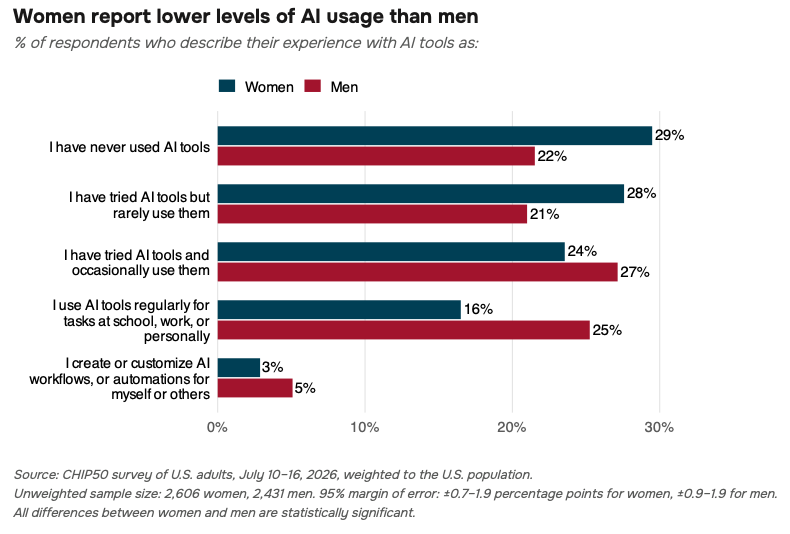
Usage measures whether and how often people use AI tools across personal and work settings. In our July 2026 survey, women were more likely than men to say they have never used AI (29% versus 22%). Men were more likely than women to say they use AI occasionally (27% versus 24%) or regularly (25% versus 16%), or that they create AI workflows or automations (5% versus 3%). Women were more likely to say they have tried AI but rarely use it (28% versus 21%)The gap holds across tools, tasks, and personal and work contexts (Figures A1 – A3). Usage is higher among younger, more educated, and higher-income adults, as well as students, employed adults, urban residents, and Asian Americans (Figure A4). The gender gap is most pronounced among those with higher education and income, and is minimal among lower socioeconomic groups, where AI use is lower.
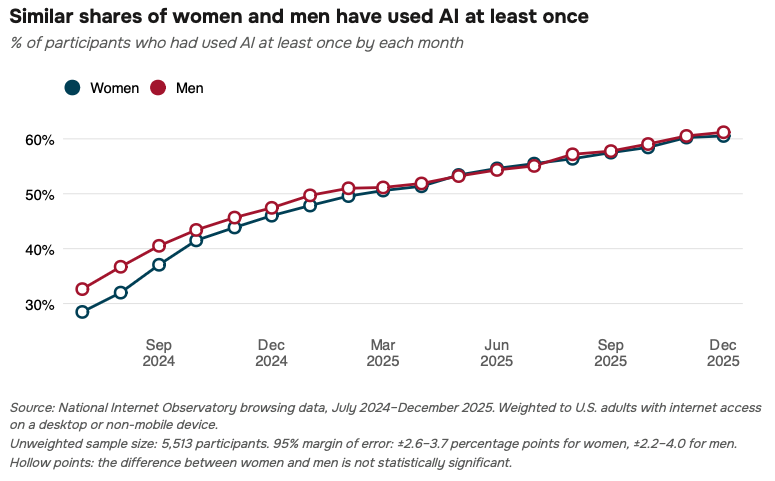
In desktop browsing data from July 2024 to December 2025, we found no statistically significant difference between women and men in having ever used AI.
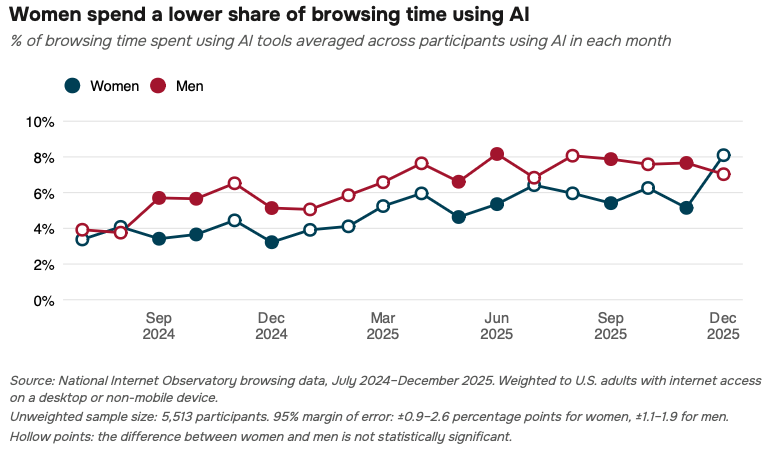
In desktop browsing data from July 2024 to December 2025, men who used AI in a given month spent a larger share of their browsing time on AI tools than women who used AI (4.6% versus 2.9% across the full period). This difference is statistically significant across the full period but not in every month.
Knowledge and awareness capture how much people know about AI, how closely they follow developments, and how familiar they are with prominent AI tools and figures. Women report paying less attention to AI developments (Figure A5), are less familiar with common AI tools (Figure A6), and express greater uncertainty about AI. Across 12 factual questions (Figure A7), women answered an average of 6.3 correctly, compared with 7.1 among men, with men more likely to answer each question correctly. The gap in the number of incorrect answers is closer (1.6 among women and 2.0 among men), while women selected “not sure” more often (4.0 questions on average, compared with 2.9 among men).
Women also say “not sure” more often than men on opinion-driven AI-related questions (% stating “not sure” to each question listed below, women first, men second):
These patterns suggest greater uncertainty among women, but some of the apparent gender gap in knowledge may also reflect greater confidence, or potentially over-confidence, among men rather than greater knowledge alone. When asked whether they recognized 12 influential people in AI alongside two fabricated names, men were more likely to report recognizing every name including the fabricated ones (Figure A8).
In a similar pattern to usage, gender differences in how much respondents pay attention to developments in AI are largest among people with a graduate degree, between the ages of 25 and 44, living in urban areas, and with household incomes over $100,000 (Figure A9), which correspond to the demographics likely to be working with, or even developing AI in their professional lives (Sajadieh et al. 2026; Pew Research Center 2026). By contrast, factual knowledge of AI has narrower gender gaps among those with high levels of education and income (Figure A10).
Women are a minority in the AI field itself. World Economic Forum data show that in 2025 about 29% of workers listing AI engineering skills were women, still under a third of the AI talent pool, and that women hold only about 12% of the most senior technology leadership roles (WEF 2025). The people who lead AI companies are overwhelmingly men, and leaders are the people in the field who appear most often in the news.
Across one year of U.S. news coverage about AI (78,542 articles collected through Media Cloud from July 2025 to June 2026), men are named and quoted far more often than women. We analyzed these articles in two ways: headlines and article text. Across the headlines, men are named 14.6 times as often as women.. Among the individuals named in five or more headlines, 219 are men and 34 are women, and men account for 93.6% of all headlines mentions against 6.4% for women. The people named most often are the men who lead AI companies.
Article text shows the same imbalance. We coded every source an article quoted or paraphrased, 252,233 in total. Just under half, 49.2%, are experts, meaning named individuals cited for their authority, position, or expertise. Among these 124,004 experts, men are cited 4.3 times as often as women. 70.1% are men, 16.2% are women, and 13.6% are people whose gender the article did not identify. Another 42.6% of all sources are organizations quoted as speaking for themselves. Counting those organizations alongside individuals, the 214,515 citations of authority experts break down to 50.1% organizations, 40.5% individual men, and just 9.4% individual women. Women make up fewer than one in ten sources cited as authorities on AI.
Because the men who run AI companies dominate this sample, we tested whether they alone explain the gap. Removing every source cited for a position rather than expertise, including executives, founders, officials, and investors, leaves 16,355 people quoted purely as subject experts. Among them, women are 24.8% of those whose gender was identified, up from 18.8% across all experts whose gender was identified. The gap narrows, but women remain about a quarter of the experts cited for their knowledge, below their roughly 29% share of AI talent.
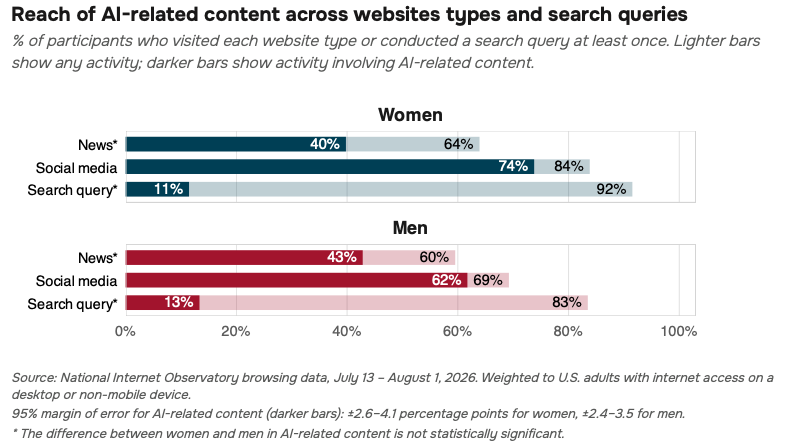
NIO browsing data shows that AI-related content (i.e. content about AI, as identified using relevant keywords. See Appendix B for more details.) is more often encountered through social media than through news websites. While 41% of panelists visited a news website containing at least one AI-related keyword, 68% encountered an AI-related keyword on social media. These differences partly reflect broader use of these website types: 62% of panelists visited a news website, compared with 76% who visited social media at least once in the data collection period.
The data also show gender differences both in how often men and women visit social media and news websites and how frequently they encounter AI-related content when they do. Similar percentages of men and women saw AI-related content on a news website. However, AI-related keywords appeared in 18% of men’s visits to news websites, compared with 12% of women’s. For social media, a greater share of women encountered AI-related content compared to men, reflecting women’s higher social media use overall. AI-related content appeared at similar rates for men (15%) than women (13%).
Finally, 1.3% of search queries by men involve an AI-related keyword compared to 0.6% of search queries by women. 11% of women have a search query with an AI-related keyword compared to 13% of men. These differences in search are not statistically significant.
This category covers how much people trust AI, the confidence and value they get from using it, their emotional reactions to it, and what keeps usage low. Concern and worry rate highest as emotional associations with AI for both genders, and women identify with these feelings more strongly, reporting more fear and anxiety than men. Men rate every positive feeling–curiosity, enthusiasm, optimism, interest, and excitement–higher than women do.
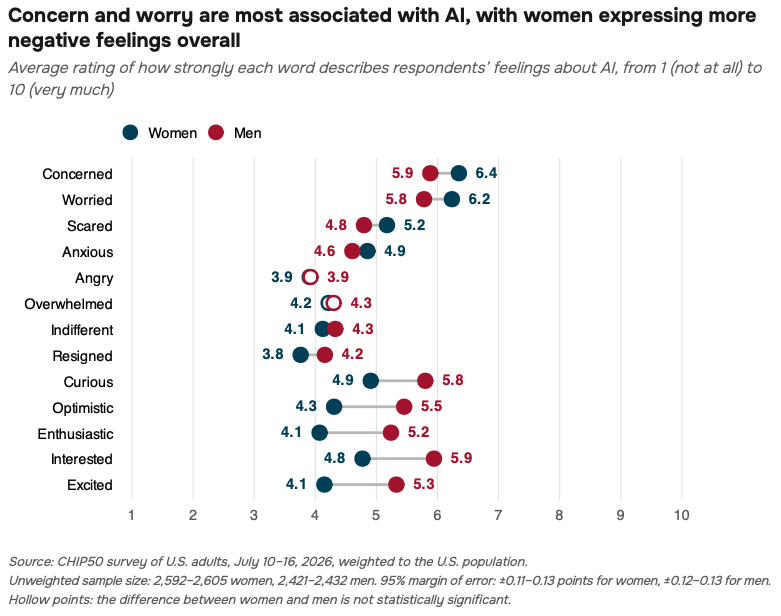
Confidence in use and perceived value of AI follow the same pattern at more moderate levels. Women report lower value (2.0 versus 2.3 on a 4-point scale) and lower confidence (2.5 versus 2.7 on a 4-point scale) across tasks, with “learning something new” and “creative projects” scoring the highest for both genders (see Figures A11 – A12 for specific tasks). Gender gaps are the widest among the highly educated and homemakers (Figures A13 – 14).
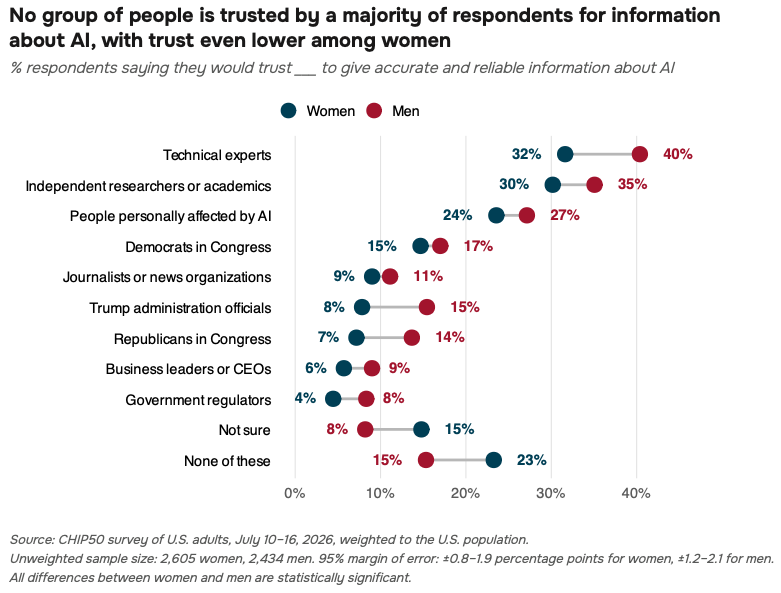
Trust in AI is low across the board. No single source is trusted by a majority of respondents to give accurate AI information, and women report lower trust than men on every measure: nearly a quarter of women (23%) trust none of the groups asked about, compared with 15% of men. Technical experts and independent researchers are the most trusted sources of information. Employers and coworkers are the most trusted to use AI responsibly (Figure A15 – A17 for additional trust related batteries).
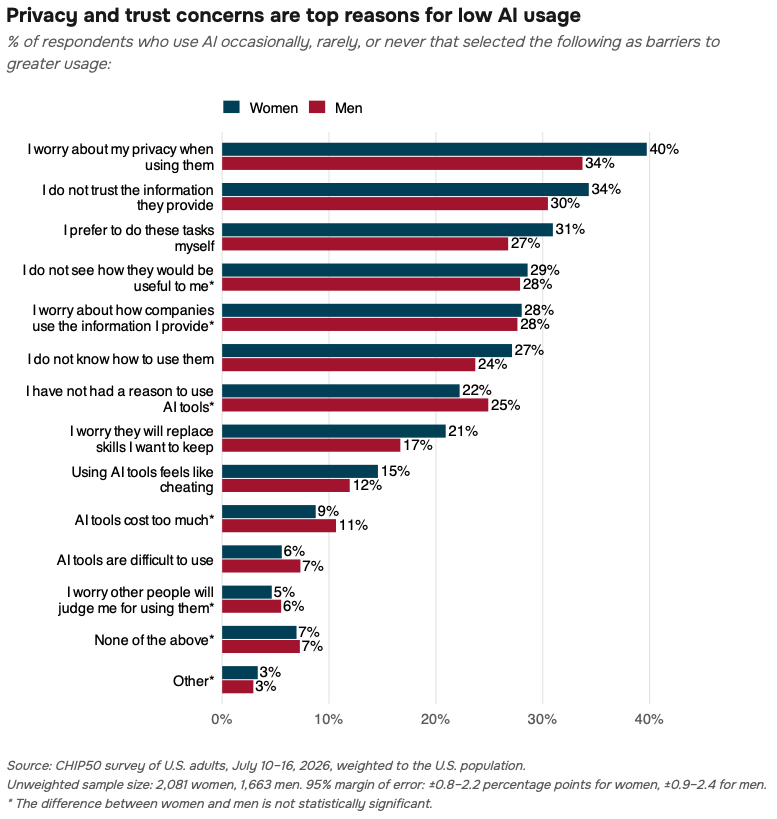
This lack of trust and low perceived value is consistent with explanations from both men and women on why they do not use AI more frequently. Privacy concerns and distrust of AI’s outputs are reported as the top two barriers to use for both genders, followed by a preference to complete tasks without AI (more common among women) and low perceived value (more common among men). By contrast, expression of fear or judgement, a barrier highlighted in recent literature (Craney, Delecourt, and Koning 2026), is less common. It ranks near the bottom of stated barriers, chosen by just 5% of women and 6% of men (see Figure A18 for more details). While women report these top barriers at higher rates, men and women rank them similarly in importance. This is in line with broader research that finds concerns of privacy and trustworthiness account for roughly a quarter of the gap in usage between men and women. Other research finds a trust gap between women and men, particularly around whether companies will protect personal data (Aldasoro et al. 2024; Arbanas et al. 2024; Cranney, Delecourt, and Koning 2026).
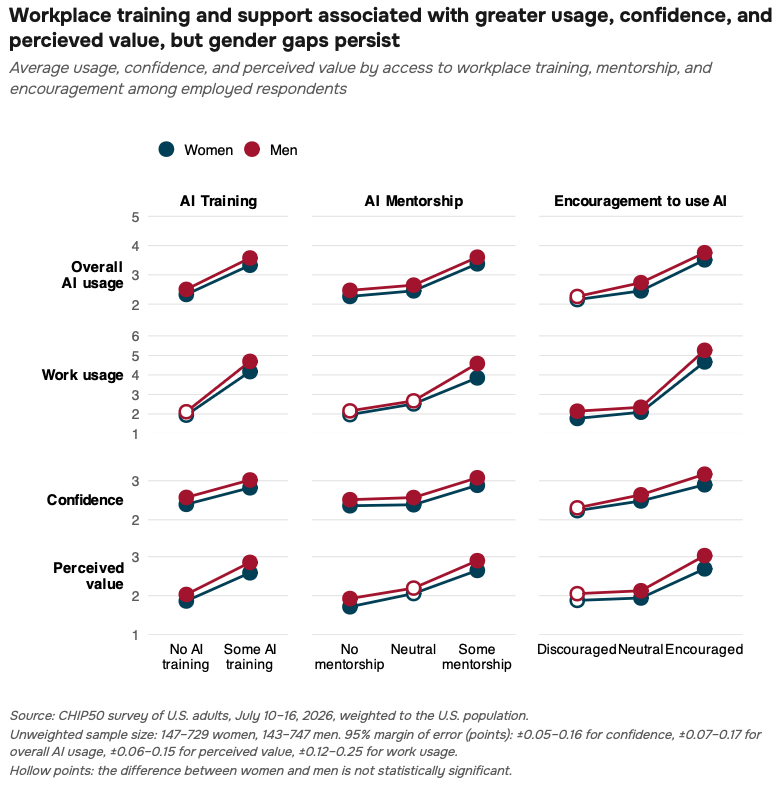
The workplace dimension covers how professional conditions are associated with AI use and value. Overall, we find that being in a work environment that encourages AI use, access to training, and mentorship is associated with greater usage, confidence in use, and perceived value across genders. However, among employed respondents, women are less likely to be in workplaces that offer these supports (Figures A19 – A21). Additionally, gender gaps often persist even among individuals with greater training, mentorship, and encouragement.
Women are also less likely to be employed in the first place (ILO 2026). Among those who are, women are more concentrated in jobs whose tasks are most exposed to automation by generative AI. Globally, 4.7% of women’s employment falls in the highest-exposure occupations, against 2.4% of men’s, and in high-income countries the gap is wider still, 9.6% of women’s jobs versus 3.5% of men’s (Gmyrek et al 2025). This reflects occupational segregation, with women overrepresented in clerical and administrative roles that generative AI can most readily perform. Separately, a study of researchers found men’s productivity gains after ChatGPT’s release outpaced women’s by more than six percentage points, alongside workplace data showing far more men than women had even tried the tool, 65% versus 47% (Tang et al, 2025).
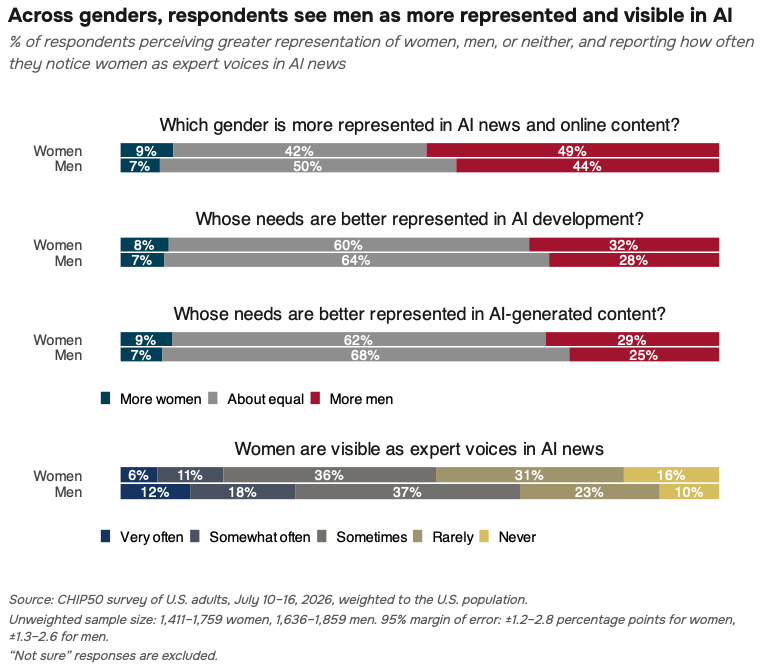
This category covers perceptions of women’s representation in AI, whether AI treats any groups unfairly, and documented bias in AI systems themselves. A consensus emerged across genders once “not sure” answers were set aside: men’s perspectives and needs are better represented in AI development and in the content AI produces, men are more associated with AI news and online content, and women’s visibility as expert voices is lower. Women are more associated with arts, healthcare, education, and social impact. Men are more associated with business leadership, engineering, government and policy, and national security (Figure A22).
On name recognition, even the most recognized woman in AI, Daniela Amodei (49%), was slightly less recognized than the least recognized men, Jensen Huang and Dario Amodei (50% each). Fei-Fei Li and Mira Murati were each recognized by 46% of respondents, the same share that reported recognizing two fabricated, common-sounding names, Susan Millner and Craig Dalton. Recognition was highest for male technology leaders whose public profiles extend well beyond AI, including Tim Cook (66%), Sundar Pichai (53%), and Satya Nadella (52%), and higher still for Elon Musk, Mark Zuckerberg, and Jeff Bezos (all above 85%). Sam Altman, the most recognized leader tied specifically to AI, was named 64% of the time. See Figure A6 for a breakdown by respondent gender. This is consistent with NIO browsing data showing that 17%, 11%, 7%, and 0.3% of individuals visited a webpage with “Sam Altman,” “Jensen Huang”, “Dario Amodei”, or “Satya Nadella” appearing on it respectively. By contrast, 1.6%, 1.3%, and 0.1% of respondents saw “Daniella Amodei”, “Mira Murati”, or “Fei-Fei Li” respectively.
On unfair treatment specifically, women are more likely to be unsure whether AI treats any group unfairly (42% versus 31% of men), while men are more likely to say that no group is. Women and men report the presence of AI bias at about equal rates, and both name Black people and low-income people as the groups treated unfairly most often. On gender specifically, each gender is somewhat more likely to say its own gender is the one treated unfairly (Figure A23). While similar shares of women (58%) and men (59%) perceive AI bias toward some groups, and 47% of women and 43% of men belong to a demographic group they believe AI treats unfairly, only 11% of women and 10% of men report personally experiencing AI-related harm (Figure A24). This suggests that perceptions of AI bias may be shaped more by social networks and media coverage than by personal experience.
Women are less likely to report access to AI training, mentorship, and encouragement at work even as these forms of support are associated with greater confidence, perceived value, and use among women and men. Employers, industry groups, and professional associations should make sure women have equal access to the information and support they need to decide when and how to use AI in their work.
Across both genders, trust in who develops AI, and who provides information about AI is low. Privacy and trust concerns are the most common barriers to using AI more, and the feelings most strongly associated with AI are concern and worry. Research should continue investigating the reasons behind these concerns, while journalists, developers and policymakers should work to build trust with greater transparency, stronger privacy protections, and the provision of credible information.
Women remain underrepresented in technical and leadership roles that shape AI systems. The people in such roles make product and safety decisions and help decide whose needs are considered during development. At best, underrepresentation may mean missed opportunities for value creation among certain groups. At worst, it may cause direct harm, reinforce existing social inequities, sow distrust, and perpetuate pipeline issues that limit who enters and advances in the field. Existing research also documents gender bias in images and text created by AI, hiring systems, healthcare applications, and other uses.
Men dominate AI news headlines and expert citations. While this reflects, in part, the prominence of male founders and executives. In expert citations, the imbalance continues after those leaders are excluded from the analysis Journalists, researchers, companies, and conveners can widen the pool of experts they feature.
AI is changing quickly. Continued research should track these gaps over time and examine differences among women across demographic groups that national averages can conceal. It should also examine how people encounter information about AI beyond traditional news, how people interact directly with AI, and how these experiences shape attitudes and behavior.
The research team included co-Principal Investigators Nancy Gibbs, Edward R. Murrow Professor of the Practice of Press, Politics and Public Policy at Harvard Kennedy School, and Matthew Baum, Marvin Kalb Professor of Global Communications, Harvard Kennedy School. Lead researchers Laura Manley, Executive Director; Allison Wan, Senior Data Scientist; and Brian Friedberg, Senior Researcher co-authored the report. Special thank you to David Lazer, University Distinguished Professor of Political Science and Computer Sciences at Northeastern University, for his input and guidance. Thanks to Kathy Pham and Kasia Chmielinski for their advice and input on this report.
This research and report were funded by Pivotal. Founded by Melinda French Gates, Pivotal is a group of organizations working to accelerate the pace of social progress for women and young people in the U.S. and around the world.
Commentary
Reports & Papers
Reports & Papers