Reports & Papers
Most Voters in States Without Voter ID Requirements Wrongly Believe ID Is Required

Note: This piece is part of Shirley Abraham’s work as a fellow at Harvard Kennedy School’s Shorenstein Center on Media, Politics and Public Policy. An award-winning Indian documentary filmmaker, Shirley’s practice moves between poetic inquiry and urgent political reality, often examining the fragile conditions under which images, memory, and dissent circulate. Her films have been recognized globally, including at Cannes, and supported by institutions such as the Sundance Institute, Pulitzer Center, Points North Institute, and IDFA Bertha Fund, among others.
At Shorenstein, her research explores freedom of thought as the beating heart of the independent voice. Shirley asks, can one create memories of the future even as the dissenting voice finds itself choked around the world today?
In the midst of an accelerated and often disorienting news cycle, this piece offers a brief pause—a space for reflection. What follows is part of that ongoing inquiry.
Listen to author Shirley Abraham recite “Time is the Task”
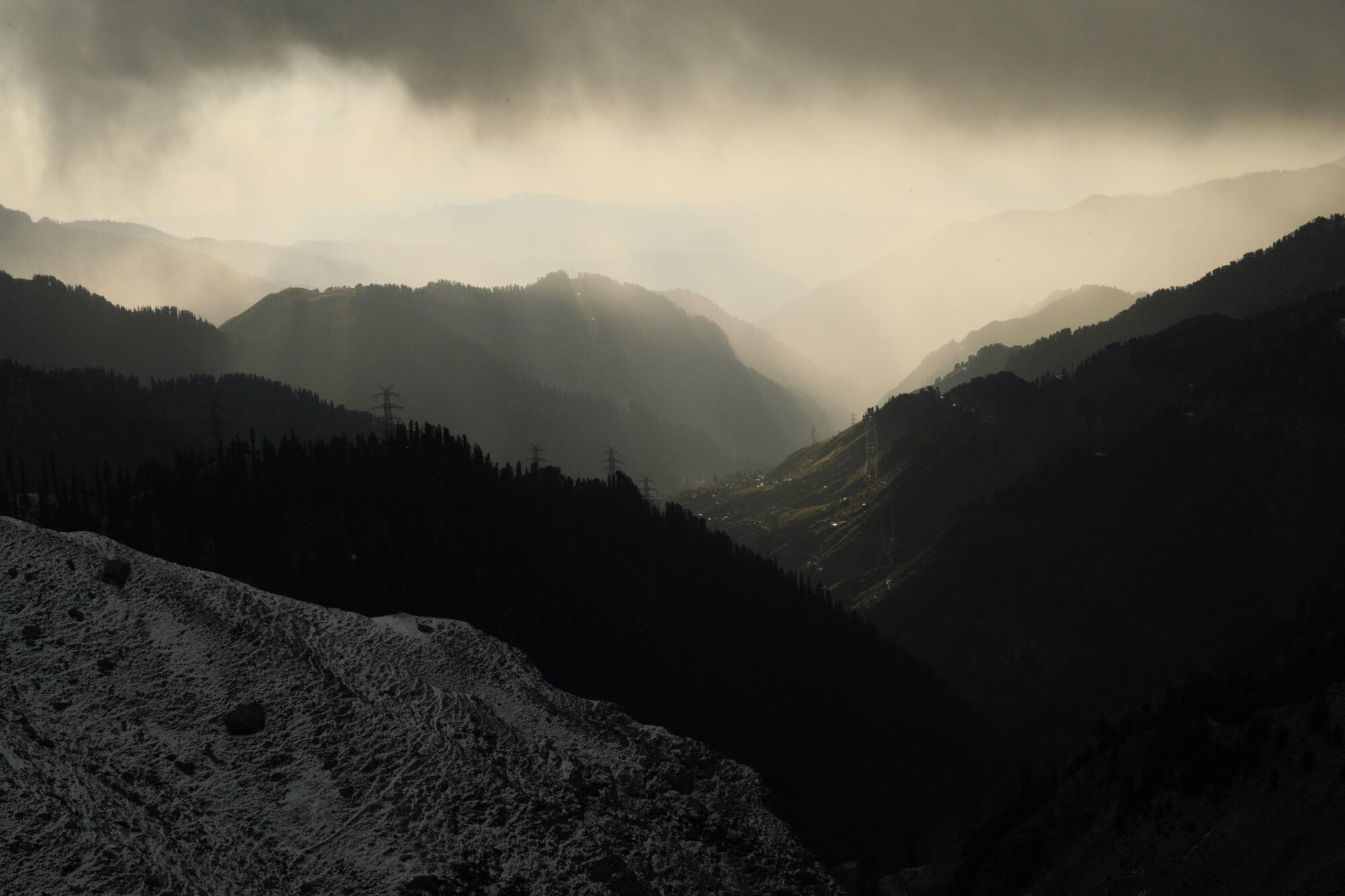
Image: Pir ki Gali (“the path of the saints”), a high mountain pass in the Himalayas. Credit: Tihany Sengupta
“A very strange thing, that if I say last year…If I say last year, I would think about 2019. That it seemed like in 2020, okay, time just stopped. And, it’s all in a blur, so when I try to, think, look back and think, about these years. It’s really… it’s all in a blur, and… one way of…recalling, like, you see, I… exactly what happened when I was talking to you, I think about the court dates. Like… Oh, it was before the… first…bail rejection in lower court. It was before the first bail rejection in high court. It was during that time when we were in Supreme Court. That’s how I… I measured, you know. I…kind of, set my calendar around. But it has happened a lot of times, and it was very weird, and…at times a little creepy that I thought that, oh, you know, last year, and then I realized, fuck, it’s not last year. It’s five years back that I’m talking about.”
~ A researcher and activist, she who must not be named.
Her partner, the student activist, has been in jail for five years. More than 2,000 days. The case hearing is yet to begin. The Supreme Court recently said that the time he has spent in jail is not unconstitutional yet.
She sees him from behind a glass screen, handing him questions from the scribes. In their next weekly meeting, he will hand back scribbles. “Restlessness” “metamorphosed to resignation” “disconnected from real” “do I even know the world anymore?” she collects them like seeds.
They say there is a Global Seed Vault in a very cold country far away. They house seeds of all known kinds, inside a sandstone mountain. If humanity were to kill itself, the next generations might figure how to feed themselves.
Meanwhile, a comedian is imprisoned for a joke he is yet to tell. Another journalist, put away for the story he is yet to write. The world’s largest democracy slides to number 159 on the World Press Freedom Index, among 180 countries.
Why are our best minds, our politically sharpest, including some of our most vulnerable, in jail? A friend hands me a galley copy of her book which will house the answer. “For exercising citizenship,” she asserts. Another friend advises hiding such books among cookbooks.
It will be six months before a journalist can speak to his wife from prison. Not in their native tongue, for the prison guards can’t catch it. So, he speaks in Hindi, a snoop-easy language. She records it, gets it translated. They speak in this one-way radio broadcast for months. Finally back home, without a trial after two years, he is trying to write his memoir.
The democracy has at least 780 languages. But you are not allowed to speak in your native tongue if consigned to prison. So an imprisoned academic wrote to his wife in “our great legacy of Colonial Aunty’s tongue,” English.
A pile of writings from political prisoners is stacking up. Why do you fear my way so much? (G. N. Saibaba) From Phansi Yard: My Year with the Women of Yerwada (Sudha Bharadwaj) Unsilenced: The Jail Diary of an Activist (Seema Azad) The Cell and the Soul (Anand Teltumbde).
Like the Voyager Golden Records, that contain images of human life, greetings in ancient languages, brainwaves, heartbeats, and laughter. Interstellar messages sent up in space aboard the Voyager in 1977, still lingering in space. Timestamps of our civilisation, made to outlast us, to contact potential extraterrestrial life.
We are obsessed with legacy. With beaming ourselves into the future, and the future generations back to us.
Is that why we do what we do? Why must we write, why do we do language, why do some of the most persecuted transit images while genocide burns them alive in their hospital beds? Palestinian film worker Zaina Bseiso calls them “messengers of urgent images.” A plea to be witnessed. Life as evidence. I am, I can exist, because you chose to see me.
And yet, most of us remain unseen. So we hope this is legacy work. Death as evidence. To be seen by the future.
Time, itself, is our task. a la Kierkegaard.
I see it as our only inoculation against the heart-hollowing hopelessness I feel on most days. The air is a hunting machine. Most of the work I wish to make threatens my liberty. “Why don’t you work at a bank?” the lawyer asks/advises/jokes. Until I have to trade work for freedom, or the other way around, language is my refuge, my only luxury. A vanity.
And so, some of the renowned writers of our time—perhaps those still free to write, are writing away, only to bury their manuscripts with the Future Library Project. To be sealed away in a specially designed silent room, and unearthed 89 years hence. Secret missives for the unborn, to be discovered and decoded like hieroglyphs.
Another imperiled artist is trying to archive the punishments of the state, creating a counter-world. She is furiously claiming back time from the jaws of the state. We fight fascism not to win, but because it is fascism, she quotes a famous line.
And that is perhaps why a single question from a scribe, enquiring about political allegiance in the face of genocide, brought down the silence of a prominent film festival, a major cultural institution. Questioning is proof we are still alive.
“I dream of seizing syllables
From each of history’s furrows”
Writes one of our most-incarcerated poets.
A filmmaker friend says that all utterances in the universe are duly recorded and retained, since known time. Scientists are trying to piece together what was sent out in the universe as sound waves even thousands of years ago.
Memory is inextinguishable.
Reports & Papers

Reports & Papers
Commentary