Center News
Announcing the finalists for the 2026 Goldsmith Prize for Investigative Reporting

Center News
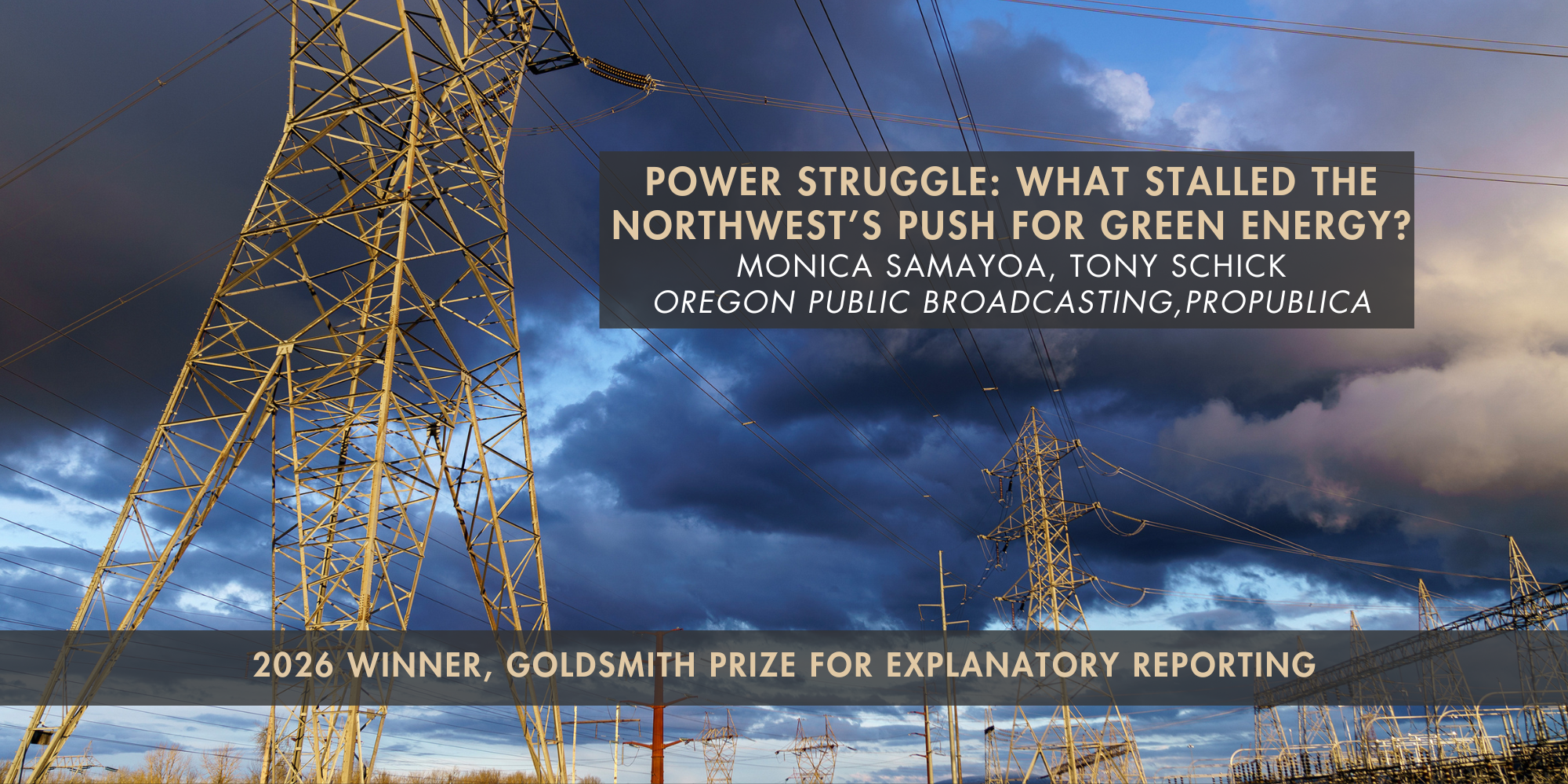
The Shorenstein Center on Media, Politics and Public Policy is pleased to announce that Power Struggle: What Stalled the Northwest’s Push for Green Energy? by reporters Monica Samayoa and Tony Schick of Oregon Public Broadcasting (OPB) is the winner of this year’s Goldsmith Prize for Explanatory Reporting. The prize will be awarded at the 2026 Goldsmith Awards Ceremony on April 9 at the JFK Jr. Forum at Harvard Kennedy School.
Produced in partnership with ProPublica’s Local Reporting Network, Power Struggle explains why states in the Pacific Northwest — despite their portrayal as leaders in green energy — rank near the bottom of the country for the growth of renewable power. This reporting team broke down green energy production and its relationship to the nation’s electrical grid and explained how the Northwest region’s electrical grid was incapable of hooking up all the new wind and solar farms that are needed to reduce fossil fuel use. The series was eye-opening to local lawmakers and served as a catalyst for reform.
“Americans are used to hearing about problems but they are seldom given the chance to learn why such problems exist and what can be done to fix them,” said Shorenstein Director Nancy Gibbs. “In Power Struggle, reporters Monica Samayoa and Tony Schick gave us a master class in explanatory reporting – pulling original data, identifying concrete barriers and agency limitations, and providing historical context to pinpoint exactly where and why Oregon and Washington had fallen so far behind in reaching their green energy goals. What emerged was a clear picture of a complex issue and a roadmap of viable solutions for policymakers to pursue.”
The selection committee for the Goldsmith Prize for Explanatory Reporting includes journalists Beth Daley and Debbie Cenziper, technology and social impact leader Kang-Xing “KX” Jin, technologist and international security expert Leisel Bogan, data scientist and entrepreneur Mike Greenfield, and media consultant and former news executive Richard Tofel. Judges recused themselves from voting on entries from their employers.
The committee also selected three finalists for this year’s Explanatory Prize for their exemplary contributions to public understanding of government in the United States.
Finalists for the 2026 Goldsmith Prize for Explanatory Reporting:
AMERICAN INERTIA
Patrick McGeehan, Winnie Hu, Todd Heisler, Junho Lee, Mika Gröndahl, Helmuth Rosales, Marco Hernandez, Peter S. Goodman, Loren Elliott, Conor Dougherty, Gabriela Bhaskar, Michael Kimmelman | The New York Times
“American Inertia is powerful explanatory journalism, translating a sprawling culture of delay and dysfunction into reporting of exceptional clarity, depth, and public value. The stories are urgent and elegantly written. The visual storytelling is especially effective, helping readers move through complicated ideas with ease and clarity. This series is a model of how ambitious journalism can illuminate not only what is broken, but why.” – Debbie Cenziper
THE NEW ENERGY CRISIS
Peter Cary, Christopher Stern | Piedmont Media
“The New Energy Crisis is an impressive and rigorously researched series that clearly illustrates the role of government and public policy amid the extraordinary strain data center growth and AI-driven computing demand are placing on the nation’s electrical infrastructure, and the impact that strain is likely to have on the environment, economy, and Americans’ daily lives.” – Leisel Bogan
WHERE THE SCHOOLS WENT
Pallavi Kottamasu, Sarah Gibble-Laska, Nathalie Escudero, Kate Malekoff | The Branch
“The series does an exceptional job using research and data coupled with qualitative insights to help people understand the factors behind changes in New Orleans’ public school system pre- and post- Katrina. It weaves in nuanced “pull back the curtain” analysis of specific educational policy choices (e.g. local vs. state control; charter schools; how — and how much — to hold local schools accountable for outcomes) and their trade-offs. Even though public schools have had and still have challenges, one leaves the series more informed about possible solutions and with hope that these challenges can be addressed.” – Kang-Xing Jin
About the Goldsmith Prize for Explanatory Reporting
The Goldsmith Prize for Explanatory Reporting seeks to honor and inspire excellent reporting that illuminates the “how” of governance in the United States – how public policy is implemented, how government systems and processes work, and what citizens can better understand about what government does. The winner of the Goldsmith Prize for Explanatory Reporting receives $15,000, to be awarded directly to the winning journalist or team.
Financial support for the Goldsmith Awards Program is provided by an annual grant from the Goldsmith Fund of the Greenfield Foundation. The program is administered by the Shorenstein Center on Media, Politics and Public Policy at Harvard University’s Kennedy School of Government. To learn more about the Goldsmith Awards visit goldsmithwards.org.
Center News
Center News