

Commentary
Rethinking Public Media, Together

Author’s Note: This is the third post as part of my research project as a Documentary Film in the Public Interest Fellow at the Harvard Kennedy School’s Shorenstein Center for Media, Politics, and Public Policy. Building from existing public media research and policy analysis, this work is shared in progress to surface points of alignment, areas of tension, and practical constraints as we consider how public-interest media infrastructure might be redesigned for today’s conditions.
_
In my last post, I wrote about reclaiming the public interest through a forward-looking redesign of public media infrastructure, adapted to today’s conditions. I suggested a reframing of public-interest media as civic infrastructure, a system designed to support their role as civic media hubs rather than legacy broadcasters or isolated nonprofits. If we can design a blueprint for such a system, our case for policymakers should reframe civic media as a public good: connecting communities, reducing isolation, expanding access to information and skill-building, and creating shared pathways towards discovering commonalities and improving community health and well-being.
Across the first two surveys accompanying this series, respondents widely agreed that this moment feels urgent, and a systems redesign is necessary. There was overwhelming support for modernizing funding, strong backing for reaffirming an independent governance structure, and sustained interest in learning from other models. There was also real curiosity about “full-stack” and “co-creation” approaches, alongside a desire for the articulation of clearer pathways around funding, governance, and implementation. This post will begin to explore what more specific pathways might look like in practice.
Right now, that shaping is happening through media consolidation. Over the past decade, mergers and market concentration have quietly redrawn the map of who controls production, distribution, and advertising. Today, just five companies account for the majority of U.S. subscription streaming revenue, with Netflix, Disney, Warner Bros. Discovery, Amazon, and Paramount controlling the dominant share of premium streaming subscriptions.
This tension is playing out in real time in the effort to block the proposed WBD-Paramount consolidation. Through my work with the Future Film Coalition and the BlockTheMerger.com campaign, we have been organizing across the independent film ecosystem to highlight how consolidation reshapes commissioning power, pathways for production and distribution, and the economic conditions under which quality media serving the public interest is produced. Future Film Coalition, alongside industry organizations including Art House Convergence, the International Documentary Association, Cinema United, and the Writers Guild, have noted in recent statements that a merger of two legacy media companies at this scale will inevitably shift bargaining leverage, licensing windows, and the negotiating position of independent producers, regional exhibitors, and freelance labor.
Consolidation decisions are infrastructure decisions, setting the parameters for what gets made, who gets paid, and who ultimately decides which stories reach the wider public. As several respondents noted in the surveys accompanying this series, these structural shifts can also disproportionately affect BIPOC creators and other historically underrepresented narratives in commercialized media markets.
The sad reality is that concentration will likely continue, and blocking a merger (while necessary) is hardly sufficient to remedy the scale of the current situation faced by independent film, local news, and the other ecosystem pieces that are part of the broader civic media infrastructure. Even if a state attorney general’s office (the most plausible candidate being California State’s AG Rob Bonta) is successful in filing a suit to block the merger, the underlying architecture will remain tilted toward market concentration, vertically integrated studios and platforms, and an increasingly narrow set of viable pathways for producing and distributing quality public interest media.
If we truly believe media ecosystems can still exist to serve a mutually beneficial public purpose, the key task ahead of us is collectively putting the work in to build systems that can exist alongside these commercial markets, and are intentional and durable enough to protect local journalism, independent storytelling, and public access to information.
It will help to zoom out, so we can stay focused on the big picture and what is at stake.
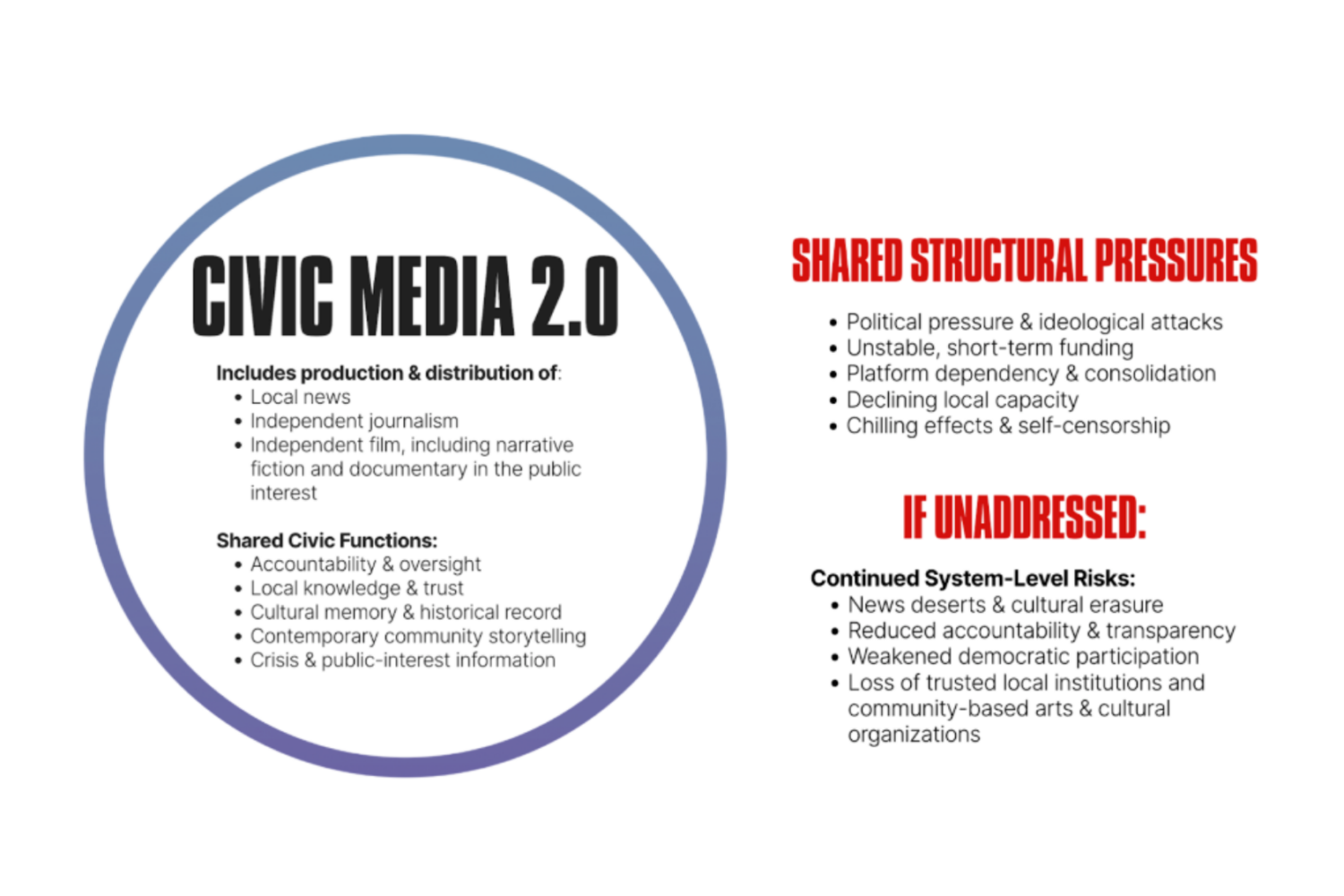
The infographic below illustrates how my research will define the proposition of a new iteration of Civic Media (Civic Media 2.0). In this framework, a revisioning of civic media includes local news, independent journalism, and independent film, including narrative fiction and documentary in the public interest. Independent film is included because it performs shared civic functions, including documenting contemporary events, preserving cultural memory, broadening perspectives often omitted from the mainstream, and informing public discourse. While this expands the traditional definition of civic media, it reflects the shared structural pressures these sectors face and the overlapping contributions they make to civic discourse, democracy, and the public information ecosystem.
Viewing civic media as an interconnected ecosystem makes the stakes clearer. When local journalism, independent film, and community-based cultural organizations weaken at the same time, the civic functions they collectively support begin to erode. Understanding this shared infrastructure is essential before we turn to the question of funding, and how today’s media economy might help sustain it.
Over the past decade, consolidation has accelerated across film, television, streaming, and digital advertising markets. The Disney-Fox merger consolidated vast film libraries under one owner. The AT&T-Time Warner transaction vertically integrated production and distribution. Streaming markets have narrowed how shows get commissioned and bought.
At the same time, local journalism has contracted dramatically. Northwestern University Medill School’s State of Local News Report from 2023 shows that the U.S. has lost more than 2,500 newspapers (roughly one-third of all local papers since 2005), and over 210 counties lack a source of local news. This is largely because advertising revenue migrated to digital platforms. Broadcast advertising used to be tied to place. For example, when a local car dealership bought time on a local station or a regional law firm could underwrite a news hour, the revenue generated from advertising stayed within the community’s local media infrastructure.
Digital advertising works differently. Revenue flows largely through centralized platforms optimized for scale and data aggregation. Companies like Google and Meta capture a dominant share of digital advertising revenue. Even when ads are targeted at a specific zip code, the bulk of the economic value accrues to the platform, not to local institutions.
Attention moves through digital platforms. Streaming services collect subscription revenue. Streaming was supposed to absorb some of that displaced advertising, but it hasn’t, hence the new streaming ad tiers. In short, the digital disruption has not restored the local economic model that once sustained local journalism, pathways for regionally-rooted storytelling, and independent film ecosystems.
If advertising and streaming revenue now power the media system, then any serious redesign for funding civic media infrastructure has to start there. This isn’t new thinking. It’s an update to an old principle.
For decades, cable systems paid franchise fees because they used public rights-of-way to deliver content into communities. For decades, local media and community non-profit media organizations relied on this revenue from cable franchise fees to support film and media arts programming for the public. However, as consumers abandon traditional cable and satellite packages in favor of digital entertainment and streaming services, that revenue base is eroding, putting even more existing civic infrastructure at risk. You can read about this more comprehensively in a 2022 report from the Alliance for Community Media of New York.
It’s clear that streaming platforms and digital advertising networks now function as the dominant communications infrastructure of our era, so we should collectively organize to modernize a similar mechanism for the platform age.
Two distinct revenue streams have emerged as candidates:
Reportedly, the U.S. spends more than two billion annually on digital advertising, yet only a fraction of that revenue circulates through local journalism or independent media ecosystems. For example, the Tech Oversight Project shows that local news sites using third-party platforms for digital advertising may retain only 49%-67% of revenue, with the remainder (33%-51%) going to ad-tech intermediaries like Google. If state and regional policymakers could commit to tapping into these existing revenue streams, imagine what it could do to reinvest a small portion of that amount that back into local civic media infrastructure across our communities.
The implications extend beyond shifting media markets and economies. The health of local information ecosystems is closely tied to the health of communities themselves. As the Knight Foundation has noted, social media platforms are fundamentally advertising businesses built to maximize engagement, not entities designed to support trustworthy local information or civic life. When the incentives of the dominant information infrastructure prioritize attention and scale over public-interest reporting, communities lose access to reliable local knowledge, cultural memory, and trusted sources of crisis information (note the parallel to commercial television markets). Reinvesting even a small portion of the advertising and streaming revenue generated within this system back into local civic media infrastructure is not just a media policy question. It becomes a community health strategy.
The image below outlines a public media funding architecture by illustrating how modernized revenue streams generated by the digital media economy could be integrated alongside traditional public and philanthropic support, allowing communities to reinvest a small portion of the economic value generated by today’s media ecosystem back into local journalism, independent storytelling, and community media institutions. The funding architecture also includes the integration of more voter-authorized public funding mechanisms (following models such as Colorado’s Science and Cultural Facilities District and King County’s Doors Open levy), including local option taxes, cultural access programs, and district-level public investments that communities can choose to implement. Additional layers include earned revenue, such as underwriting, events, workshops, and services, and donations and grants from philanthropic, government agencies, and individual sources. Together, these layers create a diversified funding base designed to produce a more stable and durable revenue stream for civic media infrastructure.
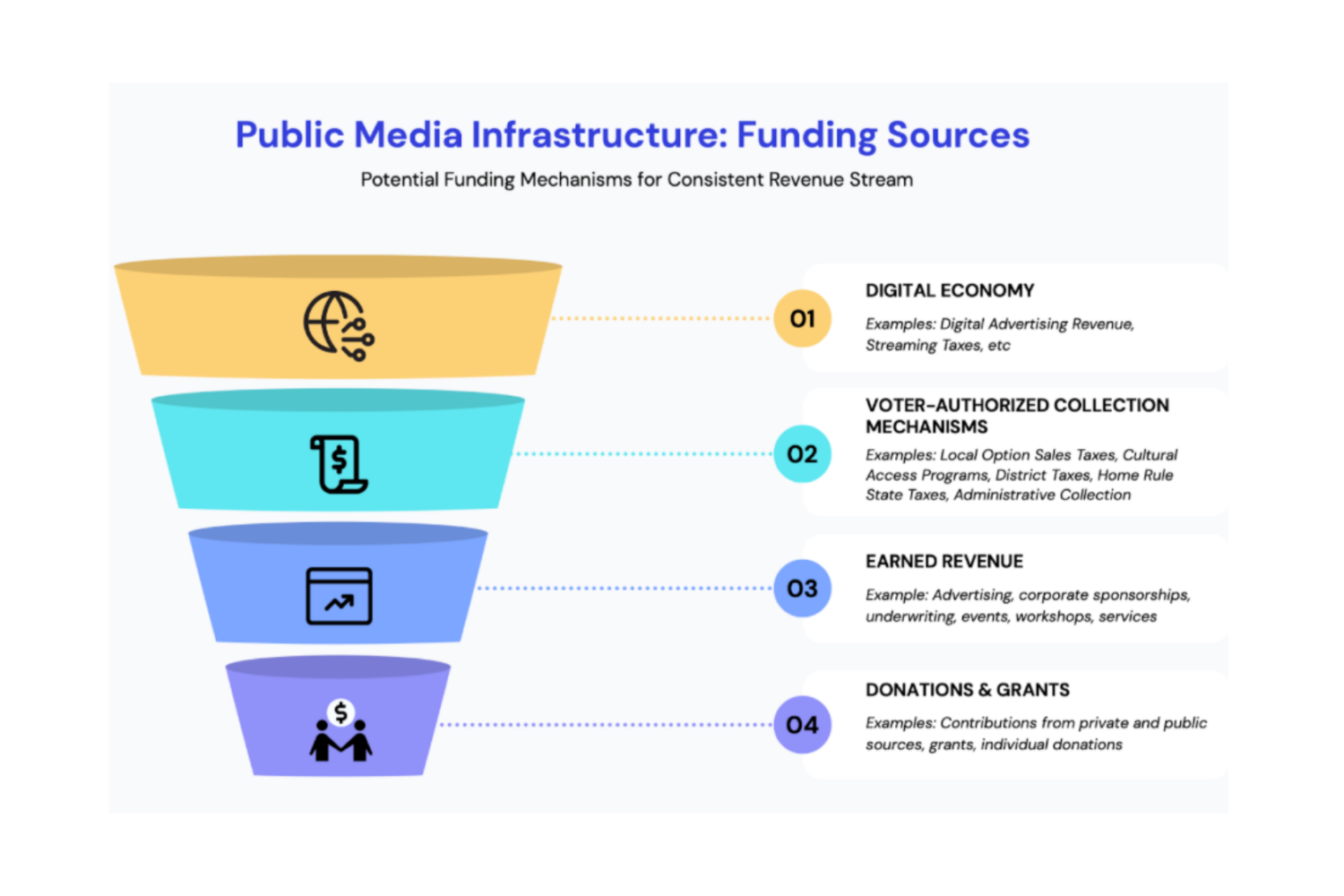
In the next post, I’ll examine these funding mechanisms in detail, including feasibility assessments, and then widen the lens to the other layers in the funding infrastructure model (see below for the infographic), such as voter-authorized collection mechanisms, earned revenue alignment, and philanthropy. Each plays a distinct role, and each carries different levels of feasibility. More to come!
In the meantime, please share your thoughts on funding mechanisms by accessing the third survey of this series.
Commentary
Commentary

Commentary